
In Short
- Cookieless analytics counts visits without placing cookies in the visitor's browser.
- In the EU and the EEA, Google Analytics 4 may only set cookies after the visitor has consented.
- With a lawfully designed banner, cookies are rejected in up to 60 percent of visits, according to etracker's 2025 study.
- Paid cookieless plans start between 9 dollars and 22 euros per month, and some tools have a free tier.
- If you advertise on Google Ads, you should generally keep GA4 and run a cookieless tool alongside it.
What Is Cookieless Analytics?
Cookieless analytics is website measurement that doesn't use cookies to recognize visitors. You still see page views, traffic sources, popular pages, and goals.
Many tools count visitors with a short code made on the server from details such as the IP address and browser type. How long that code stays the same differs between tools and settings.
The trade-off is that you learn less about each person. Following the same visitor across weeks or devices is limited or impossible.
Why Look for an Alternative to Google Analytics?
Google Analytics is the default choice. As of November 2026, W3Techs measures the tool on 46.0 percent of all websites, and it is free.
Still, many look for something else, and two reasons keep coming up.
The first is gaps in the numbers. GA4 sets cookies and can therefore only measure visitors who have said yes in the banner.
The second is uncertainty about the rules. In 2023, several European data protection authorities acted against the use of Google Analytics, and many wonder what applies now.
Is Google Analytics Legal in Europe?
As of November 2026, you can use Google Analytics 4 lawfully in the EU and the EEA, provided you obtain valid consent before the tool sets cookies. The UK has its own rules, covered further below.
Much of what is written about this dates from 2023 and is outdated. The data transfer question has moved on since then:
| Time | What Happened |
|---|---|
| July 10, 2023 | The European Commission approved the Data Privacy Framework, which makes transfers to certified companies in the US lawful. |
| September 3, 2025 | The EU General Court dismissed a lawsuit demanding that the framework be annulled. |
| November 2026 | The appeal, case C-703/25 P, is before the Court of Justice of the EU and has not been decided. |
Norway, where we are based, shows the change. In July 2023 the Data Protection Authority reprimanded the telecom company Telenor for using Google Analytics. The case concerned transfers to the US before the framework was in place.
The framework could still fall at the Court of Justice, as its two predecessors did. Check that your provider is on the list of certified companies, and don't collect more than you use.
What GA4 Doesn't Show You
Visitors Who Say No
With a standard setup, Google tags are blocked until the visitor has made a choice. If they say no, nothing is sent to Google.
If they close the banner without choosing, the result is the same. The visit doesn't exist in your reports.
Modeling Requires a Lot of Traffic
Google can fill the gap with modeled numbers. To do this, you must use advanced consent mode, and the website must have enough traffic.
The requirement is at least 1,000 events per day without consent for seven days. In addition, 1,000 daily users with consent are needed for seven of the last 28 days.
A website with a few hundred visits a day won't get there. Google itself states that modeling isn't guaranteed, even when the thresholds are met.
Detailed Data Is Deleted After 14 Months
In the free version, you can choose between two and 14 months of retention for user- and event-level data. The limit applies to explorations and funnel reports.
Standard reports with summarized numbers aren't affected. You can still see page views from three years back, but you can't build a new funnel on the old data.
Rows Can Be Hidden
GA4 withholds rows with few users when the report contains demographics or other signals that could reveal individuals. On small websites, this can make reports incomplete without you noticing.
How Much Traffic Disappears Behind the Cookie Banner?
Up to 60 percent. Etracker's 2025 consent study found that cookies are rejected in 60 percent of visits when the banner is lawfully designed.
Lawfully designed means it's just as easy to say no as yes. Websites with such banners had on average 14 percentage points lower consent than the others.
The figure varies a lot between websites. Industry, the banner's placement, and how well visitors know the sender all play a role.
Some of the loss isn't due to an active no either. In Didomi's European figures for 2025, between 21.7 and 27.4 percent left the banner unanswered.
Published averages say little about your own website. The only way to find your own number is to measure it yourself. The method is described further below.
Does Cookieless Analytics Require Consent?
It depends on where your visitors are and how the tool works. Removing cookies doesn't remove the rules on access to a visitor's device, or your duties under the GDPR when you process personal data.
EU and EEA
Article 5(3) of the ePrivacy Directive requires consent to store or access information on a user's device, with narrow exceptions. The European Data Protection Board reads the rule broadly in guidelines from October 2024. The Board also says that the rule applying doesn't always mean consent is required.
National rules differ. France's regulator CNIL exempts some audience measurement from consent on strict conditions, including a right to object. Norway has no such exception in Section 3-15 of its Electronic Communications Act.
The EU is also discussing an exemption for first-party audience measurement as part of its Digital Omnibus package. The Council agreed its position on October 21, 2026, but the proposal isn't law yet.
United Kingdom
Since February 5, 2026, UK law has had an exception for statistics. Consent isn't needed when the only purpose is to measure how your service or website is used in order to improve it.
You must explain what you do and offer a free, simple way to object. You may only share the data with others who help you improve the service.
Our Assessment of Loogika
We at Mementor developed Loogika, so read this section with that in mind.
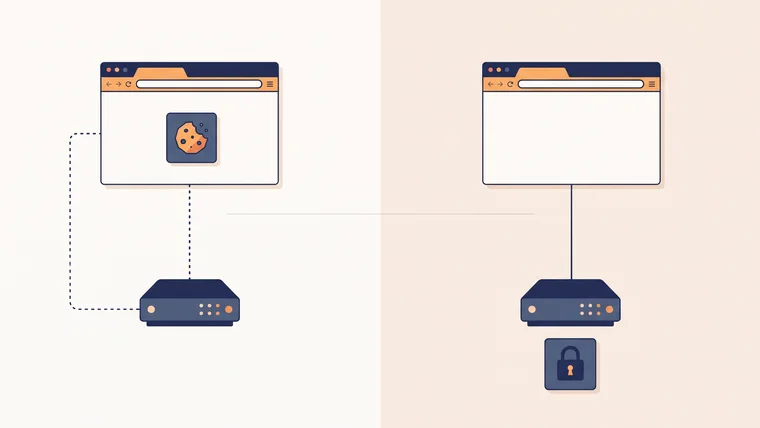
The script doesn't set any cookies and stores nothing in the browser. Visitors are counted using a code generated on the server. The code rotates every day, so no one can be followed from one day to the next.
Daily rotation is on by default on new websites. If you turn it off, you must assess consent yourself. The IP address is used to look up an approximate location and is deleted afterward.
Our professional assessment is that this measurement doesn't require consent under Norwegian rules. The assessment applies as long as daily rotation stays on.
The Norwegian Communications Authority hasn't made a specific statement about cookieless measurement. Check the rules where your own visitors are.
If you turn on session recording or link visits to logged-in users, you must reassess consent.
Other scripts on the page must also be considered separately. A Meta pixel or an embedded YouTube video still requires consent, regardless of which analytics tool you use.
Cookieless Analytics Tools: Price and Hosting
The table shows the lowest paid plan from six providers. The prices come from the providers' own pricing pages in November 2026, in the currency shown there.
| Tool | Lowest Paid Plan | Free Tier | Self-Hosting |
|---|---|---|---|
| Fathom | 15 dollars per month for 100,000 page views across 50 websites | No, 7-day trial | Not specified |
| Loogika | 19 euros per month for 100,000 events across five websites | No, 7-day trial | No |
| Matomo | 22 euros per month for 50,000 hits | Only with self-hosting | Yes, free |
| Plausible | 9 dollars per month for 10,000 page views on one website | No, 30-day trial | Yes |
| Simple Analytics | 20 dollars per month for one user | Yes, with one month of history | Not specified |
| Umami | 20 dollars per month for 1 million events | Yes, 100,000 events on one website | Yes, free |
Plausible, Fathom, Simple Analytics, Umami, and Loogika all state that they don't use cookies. You can also host Matomo, Plausible, and Umami on your own server.
Prices alone say little, since providers count differently. Some count page views, others count all events, and Matomo counts hits.
The tools also cover different needs. Plausible and Simple Analytics are built to be simple, while Matomo is closest to GA4 in scope.
Loogika combines traffic with keywords from Search Console. Tracking of rankings and mentions in AI answers is available as an add-on from 7 and 9 euros per month.
What Makes GA4 Better Than the Alternatives
Switching has a cost. These are the advantages you lose if you remove GA4 entirely:
- The price. GA4 is free regardless of traffic. All the alternatives cost money or hosting time as the website grows.
- Audiences for Google Ads. GA4 can build remarketing lists from visitors. Cookieless tools generally can't, because they don't set the cookies that ad systems rely on.
- Export to BigQuery. The free version exports up to one million events per day to Google's data warehouse.
- Expertise. GA4 is the tool most marketers already know.
History doesn't carry over either. Loogika, for example, can't import data from Google Analytics, only from Umami, Plausible, and Simple Analytics.
Should You Replace GA4 or Run Two Tools?
The answer depends on what you use the numbers for.
| Your Situation | Our Recommendation |
|---|---|
| You advertise on Google Ads and use remarketing | Keep GA4 behind consent. Add a cookieless tool to see the total traffic. |
| You only need visitor numbers, sources, and most-read pages | Switch. You'll have less data to manage and a simpler privacy footprint. |
| The website is about health, religion, or other sensitive topics | Switch. Visits can reveal sensitive information, and the Norwegian Data Protection Authority advises against tracking tools on such websites. |
| You have under 1,000 visits a day and many who reject cookies | Run two tools, or switch. GA4 won't model your traffic, so the gap will remain. |
| You have analysts working in BigQuery | Keep GA4. |
For businesses that advertise, we generally recommend two tools. GA4 delivers audiences and conversions to Google Ads advertising, while the cookieless tool shows how many actually visited.
If you want to see the two compared point by point, Loogika has a dedicated comparison with Google Analytics.
How to Test the Difference Yourself
No industry figures can tell you how much your specific website is losing. A test over a few weeks will give you the answer.
- Install a cookieless tool alongside GA4. Let both run for at least four weeks.
- Compare page views with page views. Sessions and users are counted differently across tools.
- Use the same period, time zone, and domains in both.
- Check that the tags aren't missing or duplicated on any pages.
- Open the website in a private window. Check what is sent before you choose, after no, and after yes.
The difference is an estimate, not a definitive answer. The tools filter bots differently, and ad blockers stop some scripts more often than others.
We've described the method in more detail in the project case study of Loogika, where we also explain the difference between basic and advanced consent mode.
What Is Cookieless Analytics?
Website measurement that doesn't use cookies to recognize visitors. Many tools count visits with a short code made on the server instead.
Is Google Analytics Illegal in Europe?
No. As of November 2026, Google Analytics 4 can be used lawfully in the EU and the EEA, provided you obtain valid consent before the tool sets cookies.
What Is the Best Alternative to Google Analytics?
It depends on your needs. Matomo is closest to GA4 in scope and can be self-hosted. Plausible, Fathom, Simple Analytics, and Umami are simpler. Loogika combines traffic with keywords, rankings, and mentions in AI answers.
Is There a Free Alternative to Google Analytics?
Yes. Umami has a free tier with 100,000 events per month on one website, and Simple Analytics has a free tier with one month of history. Matomo and Umami can also be self-hosted for free.
Do I Need a Cookie Banner If I Switch Analytics Tools?
Not always. Under Norwegian rules, our assessment is that the analytics doesn't need one when the tool stores nothing in the browser. Loogika has daily rotation of the code on by default, and the assessment applies as long as it stays on. Other scripts on the page, such as ad pixels and embedded videos, still require consent. The rules differ between countries.
Can I Use Google Analytics and Another Tool at the Same Time?
Yes. Many let GA4 run behind consent for Google Ads and use a cookieless tool for total traffic. Loogika itself recommends running both side by side for a few weeks before deciding.
How Much Traffic Does Google Analytics Miss?
Up to 60 percent when the banner is lawfully designed, according to etracker's 2025 study. The figure varies a lot between websites, so you should measure your own.