

Good SEO comes down to three things: technical quality, content that answers what people are wondering about, and signals that build trust. Here are 15 tried-and-tested SEO tips covering all three, with concrete steps for each tip. They apply to websites and blogs alike, from online stores to service businesses.
This list draws on over 25 years of experience with search engine optimization for Norwegian and international clients.
It also draws on this page's own numbers. In the 90 days before this update, Google showed it 658,000 times, at an average position of 11. Only 1.3 percent of those searches clicked through. That number decided which tips we rewrote first.
One important premise first. Search has changed. Fewer than a third of all Google searches now end with a click through to a website. SparkToro measured 68 percent zero-click searches in the U.S. from January to April 2026, in a study covered by Search Engine Land.
Google increasingly shows AI-generated summaries at the top of results, and many people find answers in ChatGPT and Perplexity instead.
The SEO tips below are written for both. What helps you rank in Google usually also makes you more visible in AI answers.
In Short
What You'll Learn in This Post
- Start with search intent and the technical foundation. Getting this wrong holds everything else back.
- Structure content with the answer first. This earns featured snippets in Google and citations in AI answers.
- Show who's behind the content. E-E-A-T determines who gets trusted, by both Google and AI engines.
- Update existing content quarterly. This often has a faster effect than writing new content.
- Measure everything in Search Console and GA4, including traffic from ChatGPT and Perplexity.
15 SEO Tips for Better Visibility
-
Start With Search Intent, Not the Keyword
The most important question isn't what people search for, but why. If someone googles "accounting software," they're comparing alternatives. If they google "what is accounting," they want to learn. Content that misses the intent won't rank, no matter how well it's written.
Do this: search for your own main keyword and see what's in the top 5. Are they guides, product pages, or lists? Create the same type of content, just better. Also check what AI Overviews answers for the search. It shows which sub-questions Google considers relevant to the topic.
-
Conduct Thorough Keyword Research
Keyword research determines what you should write about and which words you should use. Use Google Keyword Planner for volume, and get questions from Google Autocomplete and "People also ask."
Prioritize long-tail keywords with three to five words, like "SEO tips for online stores." They have lower volume, but higher purchase intent and much lower competition. Ten such hits often bring more relevant traffic than one ranking on a broad keyword.
Also note which questions your customers actually ask via email and phone. Those are keywords no tool will show you.
If you sell to a local market, include place names in your research, like "hairdresser Trondheim." Our guide on local SEO shows how to win the searches in your own area. You find the whole method, from brainstorming to prioritized list, in our keyword research guide. The profile that controls the map is set up with our guide to Google Business Profile.
-
Write Content That Answers First and Elaborates Afterward
Content is still the core of SEO, but structure matters more than before. Give a concise answer of 40 to 60 words right below each heading, and elaborate with examples and figures afterward. Then Google can use the answer in featured snippets, and AI engines can cite you directly.
Write the answer first, the reasoning afterward. Readers get what they came for, and the machines get something to cite.
Cover the topic thoroughly in one article instead of five thin ones. Pages with real depth win against short posts that only skim the surface. Feel free to use your own experiences and concrete cases. No competitor can copy that. Want to get better at the actual writing? We have a dedicated guide on SEO writing.
-
Match Title and Meta Description With What People Search For
The title and meta description determine whether people click on you or your neighbor in the results list. Keep the title under 60 characters, place the main keyword early, and give a concrete promise. "15 SEO Tips With Steps You Can Start With Today" beats "Welcome to Our SEO Guide."
The meta description should be under 155 characters and function like an ad. Write what the reader gets, not what the page contains. Check CTR in Search Console monthly. Pages with many impressions and low CTR are the fastest wins on the entire site.
We use this page as the example. Before this update, Search Console showed 658,000 impressions and 83 clicks in 90 days, a CTR of 1.3 percent, at an average position of 11. Part of that is the position, 9 to 11 under an AI Overview. But the old title promised nothing specific. We rewrote the title and meta description in September 2026 and are tracking the change in Search Console. We will put the new number here when we have it.

Answer first, elaboration afterward. The structure that wins in both Google and AI answers. -
Improve Page Speed
Slow pages lose on two fronts. Visitors leave them, and Google prioritizes faster alternatives. Test your website with PageSpeed Insights and GTmetrix, and pay special attention to Core Web Vitals. The full list of technical checks is in our guide to technical SEO.
The most common culprits are large images, heavy scripts, and missing caching. Compress images to WebP, enable caching on the server, and remove plugins and scripts you don't use. Among our clients, images and unused plugins are almost always the biggest bottleneck.
At VuggeBaby, an online store we rebuilt in 2026, we replaced a heavy search plugin and two paid subscriptions with lightweight solutions the store owns, and tuned caching for mobile. From March through May 2026, the store completed 132 percent more purchases than in the same period the year before.
-
Optimize for Mobile Use
About half of all web traffic comes from mobile, 49.4 percent in August 2026 according to StatCounter, and Google indexes the mobile version of your page first. If the mobile experience is poor, it doesn't help much that the desktop version looks perfect.
Test your most important pages with Lighthouse on mobile settings. Look for text that's too small, buttons placed too close together, and content that shifts around while loading. Also test forms and booking flows on an actual phone. It reveals errors no tool catches.
-
Use Internal Links Strategically
Internal links show Google and AI crawlers how your content connects, and distribute value between pages. Build topic clusters: a main page about a topic, with subpages that link to each other and up to the main page.
Use descriptive anchor text with natural words from the sentence, never "read more here." Our own rule on mementor.no is that every blog post links to at least two related guides and one service page, placed in the paragraph where the topic comes up rather than in a list at the bottom. Then the blog becomes a sales channel, not just an archive.
-
Ensure a Technical Foundation: Sitemap, Robots.txt, and Indexing
Search engines need to find and understand your pages before they can rank them. Check that the XML sitemap is up to date and submitted in Google Search Console, and that robots.txt isn't blocking important content.
Also check that robots.txt allows the AI bots that fetch sources for answers. The most important ones are OAI-SearchBot for ChatGPT, PerplexityBot for Perplexity, and Claude-SearchBot for Claude. If you block them, you disappear from their answers.
GPTBot, on the other hand, is OpenAI's training bot, and you can block it without losing visibility in ChatGPT search. Google's AI answers use the regular Googlebot, so being normally indexed is enough there. Go through the "Pages" report in Search Console quarterly and clean up errors, duplicates, and thin content.
A migration is where this goes wrong most often. When we moved stasartist.no to a new platform, every old URL, including the English variants, got a 301 redirect to the right new page, and we added structured data on nine page types and a dynamic sitemap. New users from organic search rose 199 percent in the first seven months, measured in Google Analytics against the same period the year before.

Technical SEO is the foundation. Errors here hold back the rest of the work. -
Optimize Your Images
Images affect both speed and visibility. Compress them, use WebP format, and set descriptive file names and alt texts. The alt text should describe what the image shows, in natural language, not a list of keywords.
Use lazy loading on images below the visible part of the page, and specify width and height in the code so content doesn't jump around while loading. Good images with proper markup can also generate traffic from Google Images, a channel many forget.
-
Build Authority With Backlinks and Mentions
Links from credible websites are still one of the strongest signals Google has. And for AI engines, the mention itself counts. If your brand gets mentioned in industry articles and trade media, the language models associate you with your field, with or without a link.
The most sustainable method is creating content others want to reference: surveys, statistics, tools, and thorough guides. Supplement with guest articles and participation in podcasts and webinars. Never buy links from link networks. The risk far outweighs the gain.
-
Show Who's Behind the Content (E-E-A-T)
Google assesses experience, expertise, authority, and trust when judging content quality. Anonymous content without a byline loses out to content with a visible expert behind it.
Content without a byline is content without trust. Show name, experience, and results, and you'll win in the long run.
Do this: add a byline with name, role, and relevant experience on every post. Create an author page, and link it to Person schema. Put customer reviews and certifications on the author page, not just the front page. Write in first person about your own experiences. "We tested this with a client" carries more weight than general claims.
-
Make Your Content Visible in AI Search (AEO)
More and more people find answers in ChatGPT, Perplexity, and Google AI Overviews without clicking on a single result. The goal then is to become the source the AI engines cite. This is called AEO, Answer Engine Optimization, and it builds directly on the SEO work you're already doing.
AEO is about being cited. WebMCP goes one step further and lets AI agents use your website directly. We have tested WebMCP on mementor.no.

AI engines choose few sources per answer. The goal is to be one of them. The numbers show why this is urgent. AI summaries appear in over 20 percent of Google searches, according to SparkToro's 2026 study, and in about 60 percent of searches phrased as a question, according to Pew Research Center.
Pages cited inside an AI Overview get about 2.1 percent CTR, against 0.9 percent for pages on the same results page without a citation, according to Seer Interactive, based on 5.47 million queries across 53 brands. Google's AI Mode, a dedicated chat interface in search, passed one billion monthly users in May 2026.
The key moves: structure content as questions and answers, give concise answers at the top of each section, use schema markup that matches visible content, and keep content fresh. Regularly test how the AI engines describe your company on the most important questions in your industry.
-
Update Your Content Regularly
Freshness is a ranking signal, and for AI citation, it's crucial. A post with outdated advice loses credibility with both readers and machines. Set aside time every quarter to review your most important pages.
Prioritize based on data: start with pages that have dropped in rankings, and pages with many impressions but low CTR. Update figures, replace dead examples, add new questions, and show a visible update date. A genuine update of an existing post often has a faster effect than a completely new one.
This post is the example. It was first published in May 2025 and rewritten in September 2026 with fresh numbers, new sources, and two new questions in the FAQ. The update date sits at the top of the page, and the BlogPosting schema carries the same date.
-
Fix Broken Links and Dead Pages
Broken links weaken the user experience and waste crawl budget. Links to 404 pages signal a website that isn't maintained, and that rubs off on trust in the content.
Run a regular check of both internal and outgoing links, and set up 301 redirects for pages that have been moved or removed. Check the "Pages" report in Search Console for errors, and fix them promptly. This is some of the simplest maintenance in the entire SEO field, and one of the things most often forgotten.
Want to skip the manual check? Our tool Broken Link Checker does the job. It scans up to 250 pages for free and can monitor your website and alert you when a link breaks.
-
Measure What Matters, and Adjust Accordingly
Without measuring, you don't know what's working. Use Google Search Console for queries, positions, and CTR, and Google Analytics for traffic and conversions.
Also keep an eye on AI traffic. Set up a dedicated channel group in GA4 that captures referrals from chatgpt.com, perplexity.ai, and gemini.google.com. It's small today, but growing, and it shows whether your AEO work is paying off. Set fixed monthly reviews, and adjust your plan based on the numbers, not gut feeling.
Where Should You Start? Prioritizing by Effort and Effect
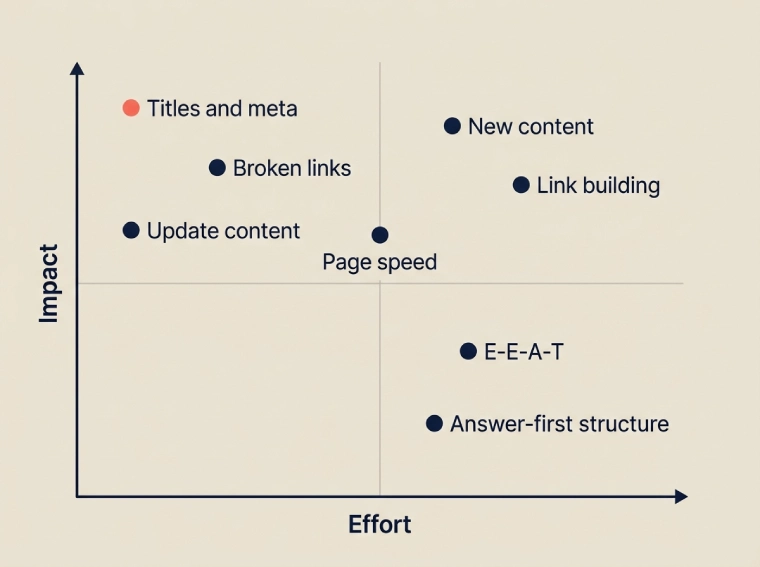
Not all measures are equally demanding, and not all deliver equally much. The table shows where you get the most out of your effort, based on what we see with our clients.
| Measure | Effort | Effect | Get Started |
|---|---|---|---|
| Fixing titles and meta on pages with low CTR | Low | High | Same day |
| Updating existing content | Medium | High | This week |
| Fixing broken links and indexing errors | Low | Medium | Same day |
| Improving page speed and Core Web Vitals | Medium | Medium | This week |
| Answer-first structure and FAQ on key pages | Medium | High | This month |
| Building E-E-A-T with bylines and author pages | Medium | Medium | This month |
| New in-depth content from keyword research | High | High | Ongoing |
| Link building and mentions | High | High | Ongoing |
Recommended Tools
You'll get far with the free tools. Paid tools become relevant when you need to analyze competitors and link profiles.
| Tool | Use Case | Price |
|---|---|---|
| Google Search Console | Queries, positions, CTR, and indexing | Free |
| Google Analytics 4 | Traffic, conversions, and AI referrals | Free |
| PageSpeed Insights / Lighthouse | Speed, Core Web Vitals, and mobile-friendliness | Free |
| Google Keyword Planner | Search volume and keyword ideas | Free |
| GTmetrix | Detailed speed analysis | Free and paid |
| Broken Link Checker | Finds and monitors broken links across your entire website | Free and paid |
| SEO-Analyse.no | Technical SEO analysis with over 30 tests and concrete actions | Free |
| Ahrefs / Moz / Semrush | Competitor analysis, link profile, and rank tracking | Paid |
SEO Tips for Beginners: How to Get Started
Fifteen tips can seem like a lot, so here's a simple order that works for most websites. Completely new to SEO? Start with our guide to SEO for beginners, then come back here.
1. Handle the Basic Technical Steps First
Check indexing, sitemap, speed, and mobile display. Errors here hold everything else back. Spend one day on Search Console and PageSpeed Insights, and make a short list of what needs fixing. Our guide on SEO analysis shows the entire review step by step.
2. Choose Your Three Most Important Pages
You cannot fix every page at once, so pick three. Look in Search Console for pages people already see in Google but rarely click. These pages are close to ranking well and need the least work. Start with the title, then the meta description, then add a few links from your other pages. In our experience, a few hours on the right page beats a full day spread across ten.
3. Set a Fixed Rhythm
SEO works more like cleaning than building. Rankings slip, competitors publish new pages, and old links stop working. Put two or three hours in your calendar every month. Use that time to check your numbers, refresh one old article, and fix anything that broke since last time. This sounds boring, and it is. It also works.
Google rewards sites that keep improving. It does not care how much you did last November.
4. Get Help Where It Pays Off
Fixing technical problems, planning content, and getting links are three different jobs. Few people are good at all of them. Think about which parts you keep putting off. Those are the parts to hand over. An SEO agency can do them faster and free up your time. A good first step is a check of where you show up today, both in Google and in AI answers.
5. Keep Up With Changes in Search
Algorithms and AI platforms change throughout the year. Follow the Google Search Central Blog for official updates, and regularly test how the AI engines answer the questions your customers ask.
Frequently Asked Questions About SEO
How long does it take before SEO delivers results?
Expect three to six months before you see clear results, and longer in competitive industries. Technical fixes and updates to existing content often have an effect sooner, often within a few weeks.
Can I do SEO myself?
Yes, quite a long way. The tips in this guide cover the essentials, and the tools are free. The line is usually drawn at technical troubleshooting, competitor analysis, and link building, where experience and tools make a big difference.
What are the best SEO tips for beginners?
Start with the basics: check that Google can index your site, fix page speed, and write titles and meta descriptions that match what people search for. Then pick your three most important pages and improve them first. The prioritization table above shows which steps give the most effect for the least effort.
How can I improve my SEO for free?
Most of the essential work costs nothing. Google Search Console, Google Analytics, PageSpeed Insights, and Keyword Planner cover measurement, speed, and keyword research. Our free tools SEO Analysis and Broken Link Checker handle the technical review. What you invest is time. A few focused hours per month takes you far.
What does SEO from an agency cost?
Norwegian agencies typically charge $90 to $200 per hour. Ongoing agreements usually run from $500 to $4,000 per month, depending on competition and scope. Our own SEO packages start at $499 per month, with no commitment period.
What is the 80/20 rule for SEO?
About 20 percent of the work gives 80 percent of the result. In our client work, that 20 percent is titles and meta descriptions on pages with impressions but few clicks, updates to content that already ranks, and a clean technical foundation. The prioritization table above is that 20 percent.
Is SEO still worth it in 2026?
Yes, but the goal has shifted. 68 percent of Google searches now end without a click, according to SparkToro, so you compete both for fewer clicks and for citations in AI answers. The same work covers both. For Stas Artist, new users from organic search rose 199 percent in the first seven months after we rebuilt the website.
What's the difference between SEO and AEO?
SEO is about ranking in traditional search results. AEO is about being cited in AI-generated answers from ChatGPT, Google AI Overviews, and Perplexity. The work overlaps, and AEO builds on a solid SEO foundation.
How does my business become visible in ChatGPT and other AI answers?
Give a short and precise answer at the top of each section, use schema markup, keep content fresh, and allow the AI bots in robots.txt. Mentions on other credible websites also count heavily. Want help? See our AEO optimization service.
Are keywords still important?
Yes, but in a different way than before. Search engines and AI models understand synonyms and context, so you don't need to repeat exact phrases. Use keywords naturally in the title, headings, and first paragraph, and cover the topic thoroughly.
Conclusion
Technical quality gets a page indexed. Content that answers the real question gets it read. Trust signals decide whether a reader believes it. The best SEO tips are the ones you put into practice, and you can start with most of the 15 above today.
Start with the technical basics, then fix your three most important pages. Set aside a few hours every month and look at the numbers before you change anything. It takes time, but it holds up. And it puts you in front of customers whether they search in Google or ask AI.