

An online store costs from $39 a month if you build it yourself on Shopify. If an agency builds it, a simple store typically costs $10,000 to $30,000.
Here are the prices for Shopify and WooCommerce, and what each payment method costs per order. You also get a worked example that shows when each platform pays off.
In Short
Shopify Basic costs $39 a month, plus 2.9% + 30¢ per card order. WooCommerce is free software, but someone has to host and maintain it.
For a US store paid mostly by card, Shopify is the cheaper platform. WooCommerce wins when Shopify adds its fee for outside payment providers, or when you need custom features.
The biggest running cost is rarely the platform itself. It is the fee on every sale, the upkeep and the marketing.
Mementor is a Norwegian web agency, and we have built and run online stores since 2015. The question we hear most before a project is what it will cost. The answer depends on the platform, the payment providers, who builds the store and what it must do after launch.
What Does an Online Store Cost in 2026?
The table shows the most common ways to get an online store in the US. The prices are for a store with a normal product range, not a large chain.
| Option | Upfront | Monthly | Best For |
|---|---|---|---|
| Build it yourself on Shopify | $0 plus your time | From $39, plus payment fees | A small range and a quick start |
| Build it yourself on WooCommerce | $0 plus your time | Hosting, domain and any paid plugins | People who know WordPress |
| Freelancer | $3,000 to $15,000 | Platform, fees and upkeep | A simple store with a clear scope |
| Agency, simple store | $10,000 to $30,000 | $100 to $500 for maintenance | Businesses that want it done right from the start |
| Agency, custom design and integrations | $30,000 to $100,000 | $100 to $500 for maintenance | Stores with inventory, accounting and several sales channels |
| Large builds | From $100,000 | By agreement | Many products, B2B or several countries |
The freelancer and agency ranges are our estimate of the US market. They vary with how much is built from scratch, and how many systems the store must talk to.
The Platforms: What They Cost per Month
The platform is the software that shows your products, takes orders and sends receipts. Most small US stores choose between Shopify and WooCommerce. BigCommerce, Squarespace and Wix are the other common options.
| Platform | Per month (annual billing) | Extra fee on outside payment providers | Who maintains it |
|---|---|---|---|
| Shopify Basic | $39 ($29) | 2% | Shopify |
| Shopify Grow | $105 ($79) | 1% | Shopify |
| Shopify Advanced | $399 ($299) | 0.6% | Shopify |
| WooCommerce | $0 for the software | None | You or your agency |
| BigCommerce Core | $39 ($29), up to $30,000 in yearly sales | 2% on providers outside its embedded list | BigCommerce |
| Squarespace Basic | $25 ($19) | 2% on all store sales | Squarespace |
Shopify
Shopify is a finished platform you rent. Hosting, security and updates are part of the monthly price. You can have a simple store live in a few days.
The trial is three days free, then $1 a month for the first three months. After that, the full plan price applies, as listed on Shopify's pricing page.
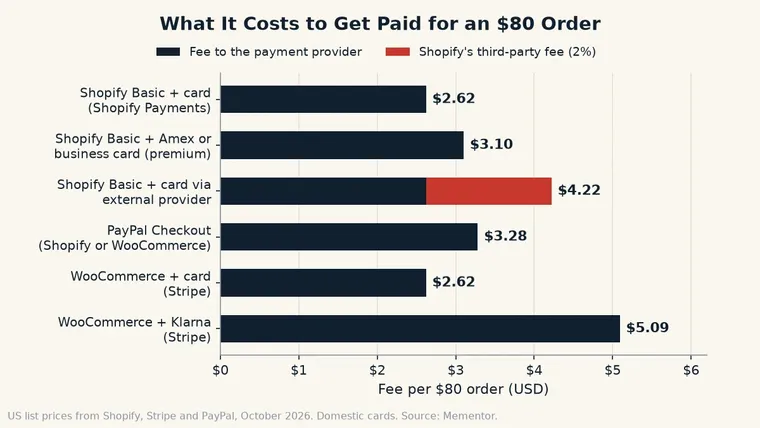
Card payments go through Shopify Payments. On Basic, a standard US card costs 2.9% + 30¢ online. American Express and business cards count as premium cards and cost 3.5% + 30¢ on Basic.
Use a payment provider outside Shopify Payments, and Shopify adds its own fee of 2% on Basic. That comes on top of what the provider charges. PayPal is exempt from it when Shopify Payments is active, according to Shopify's help center.
WooCommerce
WooCommerce is a free plugin that turns a WordPress site into an online store. The software costs nothing, and WooCommerce takes no cut of your sales. You own the code and the data.
The price of that freedom is upkeep. WordPress, WooCommerce and the plugins need regular updates, and someone must handle security and backups.
You do that yourself, or you pay an agency to do it. Read more in our complete WooCommerce guide.
BigCommerce, Squarespace and Wix
BigCommerce prices its plans by sales volume. Core costs $39 a month and covers up to $30,000 in sales over the past twelve months. Pass that, and the plan moves up to Growth at $105, then to Scale at $399.
A store selling $10,000 a month would land on Scale, according to BigCommerce's pricing page. There is no extra fee with providers on its embedded list, which includes Stripe. Other providers cost 2% extra on Core.
Squarespace and Wix are mainly website builders with a store built in. Squarespace Basic costs $25 a month and adds a 2% fee on store sales. The Core plan at $39 drops that fee.
Wix lists Core as its cheapest plan that takes payments, at $29 a month on annual billing. Both work for a small range of products.
Payment Fees: The Cost That Follows Every Sale
The platform is the store itself. The payment provider moves the money from the customer to you. Most US stores offer cards, PayPal, Apple Pay and Google Pay, and many add buy now, pay later.
Each one takes a fee per order, and the fee grows with your sales. The table shows US list prices as of October 2026.
| Payment method | Fee per order | Monthly fee | Best for |
|---|---|---|---|
| Cards via Shopify Payments (Basic) | 2.9% + 30¢, premium cards 3.5% + 30¢ | Part of Shopify | Card payments on Shopify |
| Cards via Stripe | 2.9% + 30¢ | None | Cards on WooCommerce and other platforms |
| Apple Pay and Google Pay via Stripe | 2.9% + 30¢ | None | Fast checkout on mobile |
| PayPal Checkout | 3.49% + 49¢ | None | Customers who prefer PayPal |
| Klarna via Stripe | 5.99% + 30¢ | None | Larger orders paid over time |
| Affirm or Afterpay via Stripe | 6% + 30¢ | None | Larger orders paid over time |
Cards, Apple Pay and Google Pay
Stripe handles card payments, including Apple Pay and Google Pay. According to Stripe's US pricing page, a domestic card costs 2.9% + 30¢. There is no setup fee and no monthly fee.
International cards cost 1.5% extra at Stripe, and currency conversion adds another 1%. On Shopify Payments, international cards add 1%.
Two costs are easy to miss. Refund a sale, and Stripe keeps its processing fee. A chargeback costs $15, and responding to it costs another $15 that you get back if you win.
On WooCommerce, you connect Stripe with a free extension, or use WooPayments at the same US rates. On Shopify, cards go through Shopify Payments at 2.9% + 30¢ on Basic and 2.7% + 30¢ on Grow.
PayPal
PayPal Checkout costs 3.49% + 49¢ per order in the US, according to PayPal's fee page. Pay with Venmo costs the same. Refund an order, and PayPal keeps the original fee.
US stores on Shopify can offer PayPal through Shopify Payments, at the same listed rate. Shopify charges no third-party fee on PayPal when Shopify Payments is active. On WooCommerce, you add PayPal with its free plugin.
Buy Now, Pay Later
Buy now, pay later lets the customer split the payment. The store gets paid up front, and the provider carries the risk if the customer stops paying. That is why it costs more per order than cards.
Through Stripe, Klarna costs 5.99% + 30¢ per order, while Affirm and Afterpay cost 6% + 30¢. WooPayments uses the same US rates. A direct agreement with Klarna, Affirm or Afterpay is priced by quote.
On Shopify, buy now, pay later comes through Shop Pay Installments, which Affirm runs. Shopify shows the rate in your admin but does not publish it. These plans work best on larger orders, where the fixed 30¢ matters less.
Worked Example: Shopify or WooCommerce?
Take a store with $10,000 in monthly sales. The average order is $80, which gives 125 orders a month. First, assume every customer pays with a standard US card.
For WooCommerce we use our own SLA at $150 a month, which includes hosting, updates and backups. All prices are with monthly billing.
| Cost per month | Shopify Basic | Shopify Grow | WooCommerce with SLA |
|---|---|---|---|
| Platform | $39 | $105 | $0 |
| Hosting and maintenance | Included | Included | $150 |
| Card fees (2.9% or 2.7%, plus 30¢) | $327.50 | $307.50 | $327.50 |
| Total | $366.50 | $412.50 | $477.50 |
Shopify Basic is $111 a month cheaper than WooCommerce with an SLA. That adds up to $1,332 a year. With annual billing on both, the gap shrinks to $83.50 a month.
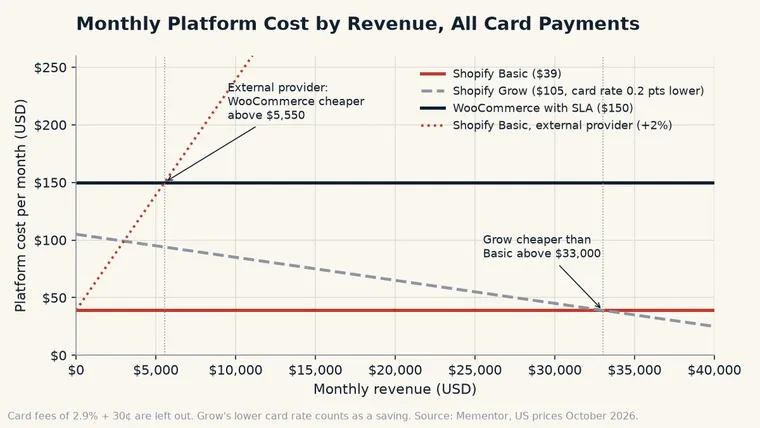
The card fee is the same, because Stripe and Shopify Payments both charge 2.9% + 30¢ on Basic. With standard cards, the gap stays at $111 no matter how much you sell. Grow only beats Basic above $33,000 a month, when its lower card rate covers the higher plan price.
Where WooCommerce Catches Up
Two things can flip the result. The first is the 2% fee Shopify Basic adds on sales through outside providers.
That fee applies if Shopify Payments is not available for your business, or if you run cards through your own merchant account. Once those sales pass $5,550 a month, WooCommerce with an SLA becomes cheaper than Shopify Basic.
The second is premium cards. American Express and business cards cost 3.5% + 30¢ on Shopify Basic, while Stripe charges 2.9% + 30¢ for domestic cards. Above $18,500 a month in premium card sales, that gap outweighs the $111.
This matters most for B2B stores, where many buyers pay with company cards.
With a Mix of Cards, PayPal and Buy Now, Pay Later
Few stores get every payment by card. So we run the same store with a mix of 64% cards, 24% PayPal and 12% buy now, pay later. The split is an example, not an industry average.
On WooCommerce, cards and Klarna go through Stripe, and PayPal through its own plugin. On Shopify, cards and PayPal go through Shopify Payments.
| Cost per month | Shopify Basic | WooCommerce with SLA |
|---|---|---|
| Platform | $39 | $0 |
| Hosting and maintenance | Included | $150 |
| Cards ($6,400, 80 orders) | $209.60 | $209.60 |
| PayPal ($2,400, 30 orders) | $98.46 | $98.46 |
| Buy now, pay later ($1,200, 15 orders) | $76.38* | $76.38 |
| Total | $423.44 | $534.44 |
* Shopify does not publish the Shop Pay Installments rate. We use Stripe's Klarna rate of 5.99% + 30¢ on both sides, so the comparison stays fair.
The gap is $111 again. PayPal and buy now, pay later cost the same on both platforms, so only the monthly base differs.
Say you add Klarna to Shopify as an outside provider instead. Basic then adds 2% on those sales, which is $24 a month here, and Shopify still comes out ahead.
The examples leave out paid apps, plugins and your own time. Use them as a starting point, and run the numbers on your own mix of payment methods.
What Does It Cost to Have the Store Built?
An agency's price depends less on the platform and more on what has to be in place. Five things push the price up.
- The number of products and variants to add and structure.
- Custom design instead of a ready-made theme.
- Connections to accounting, inventory or ERP systems.
- Product feeds for Google Shopping and other channels.
- Moving from an old store, with customers, order history and redirects.
The last item is often underestimated. Move a store without redirecting the old URLs, and you lose your Google rankings. Rebuilding them costs more than doing the move right.
Watch out for fixed prices that look low. Ask what is included for product entry, payment setup, shipping and testing. Anything missing from the quote tends to come back on an hourly invoice.
If you are weighing a regular website instead of a store, we have a separate guide to how much a website costs.
Costs After Launch
Launch is where the running costs start. These items come back every month.
- Maintenance and updates. Included in Shopify. For WooCommerce, you pay an agency or spend your own time.
- Apps and plugins. Filters, reviews, shipping labels and loyalty programs often carry their own monthly or yearly price.
- Email marketing. Many tools charge by the number of contacts, so the price rises with your list.
- Shipping. You ship with USPS, UPS or FedEx, and the price per package depends on weight, distance and your rates. Shopify lists discounts of up to 87% on labels bought through Shopify.
- Marketing. Often the biggest item. See what Google Ads costs and what SEO costs.
Sales Tax
US online stores also have to handle sales tax. Since the Supreme Court's 2018 decision in South Dakota v. Wayfair, states can require out-of-state sellers to collect it. That applies even if you have no office or warehouse in the state.
Every state with a sales tax now has such a rule, called economic nexus. The threshold varies by state, for example $100,000 in sales in many states and $500,000 in California.
See the Sales Tax Institute's state-by-state chart for the current limits. Ask an accountant how the rules apply to your store.
Example: What a Growing WooCommerce Store Needs
Vuggebaby is a Norwegian online store that sells personalized baby products, and we have run it since August 2025. The store runs on WordPress and WooCommerce, with PHP 8.4 and a LiteSpeed server. It shows where the costs land once a store grows past the startup phase.
The store has over 35 custom modules. Each one solves something that would otherwise need a paid plugin with a monthly price. That costs more to build, but the store avoids a growing pile of subscriptions.
Three other choices show where the money should go.
- Server-side tracking. Purchases are measured on the server through Stape, so Google Ads gets accurate conversion data even when the browser blocks tracking.
- A product feed through Channable. Product data is cleaned and rebuilt before it goes to Google Shopping. Better data gives ads that match the right searches.
- Email on its own server. The store moved from Klaviyo, which charges by contacts, to FluentCRM on its own server. The price no longer follows the size of the list.
We stepped up the Google Ads work in March 2026. From March to May, revenue was 108 percent higher than the same period the year before. Purchases rose 132 percent and new customers 138 percent, measured in Google Analytics.
Read the full Vuggebaby case study.
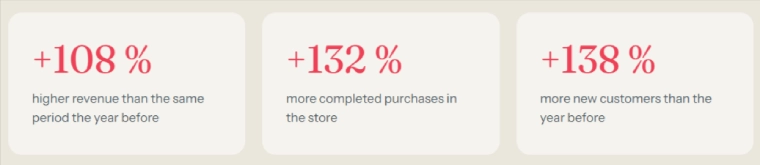
The lesson is simple. The numbers moved because of the data behind the ads, more than the design.
Shopify or WooCommerce: Which Fits You?
Choose Shopify if you have a small range and want to skip maintenance. In the US, it is also cheaper when most customers pay through Shopify Payments.
Choose WooCommerce if the store needs custom features, connections to other systems or full control over data and code. It also pays off when much of your volume goes through outside providers, or when many buyers use business cards.
If you are unsure, think three years ahead. Switching platforms later costs far more than choosing right now.
Still deciding whether to start at all? First read our guide on whether an online store is profitable. When you are ready, we have 12 tips for starting an online store.
What Does an Online Store Cost at Mementor?
We build online stores on WooCommerce. The build is priced as a fixed project, and we agree on the price before we start. You know what you pay and what is included.
After launch, the store moves to our Service Level Agreement (SLA). It costs $150 a month, $125 with half-yearly billing or $112.50 with yearly billing, and includes hosting. Our hourly rate is $139.90.
See what we offer on our page about starting an online store, or compare all our prices. Get in touch for a fixed quote.
Frequently Asked Questions
How much does it cost to start an online store?
If you build it yourself, you can start for under $50 a month. Shopify Basic costs $39 a month, and WooCommerce only needs hosting. An agency typically charges $10,000 to $30,000 for a simple store, and every sale carries a payment fee on top.
How much does Shopify cost per month?
Basic costs $39 a month, or $29 with annual billing. Grow costs $105 and Advanced $399. Card payments through Shopify Payments add 2.9% + 30¢ per order on Basic.
Is WooCommerce free?
The software is free, and WooCommerce takes no cut of your sales. You pay for hosting, a domain, any paid plugins and maintenance. You do the maintenance yourself or buy it from an agency, for example our SLA from $112.50 a month.
What are Stripe fees?
In the US, Stripe charges 2.9% + 30¢ per domestic card payment, with no setup or monthly fee. International cards cost 1.5% extra, and currency conversion adds 1%. Stripe keeps its fee if you refund a sale, and a chargeback costs $15.
How much does an agency charge to build an online store?
Our estimate for the US market is $10,000 to $30,000 for a simple store. With custom design and connections to accounting or inventory, expect $30,000 to $100,000. Ask for a fixed price and check what is included for products, payments, shipping and testing.
What does it cost to run an online store each month?
Plan for the platform, payment fees, apps, email marketing, shipping and marketing. On Shopify, maintenance is part of the monthly price. For WooCommerce, an SLA covers hosting, updates and backups, and ours costs from $112.50 a month.
Which ecommerce platform is cheapest?
For a US store paid mostly by card, Shopify Basic is usually cheapest. In our example with $10,000 in monthly sales, it costs $111 a month less than WooCommerce with an SLA. WooCommerce catches up when Shopify adds its 2% fee on outside payment providers.
Does Shopify charge transaction fees?
Not when you use Shopify Payments, where you only pay the card rate. With an outside payment provider, Shopify adds 2% on Basic, 1% on Grow and 0.6% on Advanced. PayPal is exempt from that fee when Shopify Payments is active.
How to Set Your Budget
Start with the sales you expect in the first year, and how your customers will pay. That tells you whether Shopify or WooCommerce is cheaper for you.
Then add the build, maintenance and marketing. Set aside the most for marketing. A store nobody finds does not sell, whatever it cost to build.