
In Short
Choose a solution that answers from your own pages and says so when it does not know. Ready-made AI agents for small businesses cost from a few hundred dollars a year. Label the agent as AI from the first message, and let a person handle prices, agreements and advice, because the business is responsible for what the agent says.
What You'll Learn in This Post
- The difference between a rule-based chatbot, an AI chatbot and an AI agent
- What an AI agent can do for a business, and what it should not do
- How much work it realistically saves, with a worked example
- What an AI agent costs, and which pricing models exist
- What the EU AI Act and privacy rules require of you in 2026
- Seven questions to ask before you choose a vendor
What Is the Difference Between an AI Agent and a Chatbot?
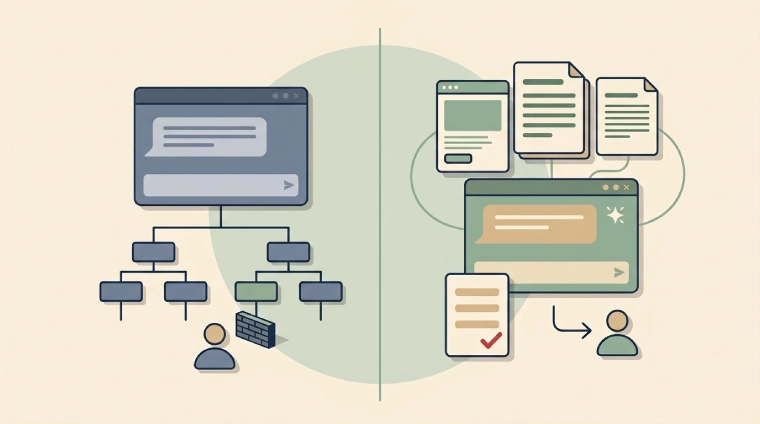
A chatbot is a program that answers in a chat window. The oldest chatbots are rule-based. The customer clicks through buttons or types words that trigger a pre-written answer. If the customer asks about something that is not in the script, the conversation stops.
An AI chatbot uses a language model and understands everyday language. It can phrase answers on its own, but the answers are often based on general knowledge. That means it can get things wrong about your business, your prices or your terms.
An AI agent does more than answer. It takes the answer from the company's own sources, such as the website, price lists and terms, and it can carry out a task. That could be collecting details for a quote, checking an order or passing the case on to the right person.
| Rule-based chatbot | AI chatbot | AI agent | |
|---|---|---|---|
| Understands everyday language | No, only known words and buttons | Yes | Yes |
| Where the answer comes from | Pre-written answers | The language model's general knowledge | The company's own pages and documents |
| Can carry out tasks | Only fixed forms | Rarely | Yes, for example collecting quote details |
| When it does not know the answer | Stops or sends the customer to a form | Risk of guessing | Says so and offers a person |
| Work to keep it up to date | High, every answer is written by hand | Low, but little control | Low, updated from the website |
The lines are not sharp, and many vendors call everything an AI agent. So always ask where the answers come from, and what the solution does when it does not know the answer. You will also see the term agentic AI used for the same idea.
The term AI agent is also used for something else: AI tools that visit websites and act on behalf of a person. We write about that kind of agent in the article about WebMCP. This article is about the agent that answers your customers on your own website.
What Can an AI Agent Do for a Business?
The biggest value is in the questions that come back every week. Opening hours, service area, prices, return rules and what happens after an order are typical examples. The answers are often on the website already, but the customer does not find them.
Here are three examples of what an AI agent does in practice.
- Plumber. The customer asks if you take jobs in the next town over. The agent says yes, asks what the job is about and asks for a photo and a phone number. You get a fully described request in your inbox.
- Online store. The customer wonders if a jacket runs large and how long delivery takes to Alaska. The agent answers from the product text and the shipping page, and links to the right product.
- Law firm. The customer describes a dispute with a contractor. The agent does not give legal advice, but it explains which cases the firm takes, what a first meeting costs, and collects contact details.
The agent also gives you a log of what customers want to know. The log shows what is missing on the website. Questions that keep coming back are answers that are missing where the customer makes the decision. Fixing them is one of the fastest wins in conversion rate optimization.
What an AI Agent Should Not Do
The business is responsible for what the agent says. In 2024, the Air Canada chatbot promised a customer a refund under rules that did not exist. The airline argued that the chatbot was responsible for its own answers, but the Civil Resolution Tribunal in British Columbia rejected that and ruled for the customer.
So do not let the agent give binding prices, legal or medical advice, or promises that are not written in your terms. Have it collect the details instead, and let a person give the final answer. A good agent says clearly when it does not know something.
Customers also want a person to be available. In 2024, Klarna reported that its AI assistant did the work of 700 customer service agents. In 2025, the company started hiring people again, because the CEO said cost had weighed too heavily and quality had dropped.
How Much Work Does an AI Agent Save?
Gartner predicts that AI agents will resolve 80 percent of common customer service issues without human help by 2029. That is a forecast for large contact centers, not a promise for a small business. A better starting point is to count your own inquiries.
The example below is a service business that gets 300 inquiries a month by email, phone and chat. The figures are a worked example, not an average from a survey.
| Calculation | Value |
|---|---|
| Inquiries per month | 300 |
| Share of simple questions answered on the website | 60 percent, or 180 |
| Time per answer today | 4 minutes |
| Time saved per month | 720 minutes, or 12 hours |
| Value at an internal cost of 50 USD per hour | 600 USD |
The time saved is rarely the most important part, though. The biggest gain is often the inquiries you get outside business hours, when no one answers the phone. A customer who gets an answer at ten in the evening does not move on to the next vendor in the search results.
What Does an AI Agent Cost?
The price depends mostly on the pricing model. There are three common models, and they suit different businesses.
| Pricing model | Example | Best for |
|---|---|---|
| Fixed monthly price with a quota | 49 to 199 USD a month for 800 to 8,000 answers with us | Small and midsize businesses that want predictable costs |
| Price per resolved case | Intercom charges from 0.99 USD per resolution, plus 29 to 132 USD per seat a month | Businesses with their own customer service team and a high case volume |
| Custom-built solution | Hourly rate for development, plus ongoing cost for the language model | Large companies with special needs and their own systems |
Also look for the costs that are not on the front page. That means setup, the price when you go over the quota, and who keeps the agent up to date when services and prices change. With us, extra answers cost 24.90 USD per 1,000. On Plus and Pro, setup is included with a 12-month agreement. Otherwise it costs 990 USD. You will find the details on the Mementor AI Agent page.
The price per resolved case looks low, but it grows with use. With 1,000 resolved cases a month, you pay at least 990 USD to Intercom, on top of the seat licenses. For a small business, a fixed monthly price usually gives more control.
The Rules in 2026: The AI Act and Privacy
The Transparency Duty in the EU AI Act
From August 2, 2026, Article 50 of the EU AI Act applies in the EU. It says people must be told that they are talking to an AI, unless it is completely obvious. The information must be clear and come no later than the first contact, not hidden in a footnote.
The EU has postponed several of the rules for high-risk AI to December 2027, but the transparency duty for chatbots has not been postponed. Breaches can lead to fines of up to 15 million euros or 3 percent of global annual turnover, with lower caps for small and midsize businesses.
Does It Apply Outside the EU?
Yes, in many cases. The AI Act covers businesses outside the EU when their AI system is used by people in the EU. If your chatbot answers customers in Europe, you should follow the rule now, wherever your company is based.
If you only sell in your home market, it is still smart to label the agent from the start. Similar rules are coming in other places, and you avoid having to change the solution later. Customers also know what they are talking to.
Privacy Rules Already Apply
Chat logs often contain names, phone numbers and details about the customer's situation, and that is personal data. If you serve customers in the EU or EEA, the GDPR applies in full today. You need a data processing agreement with the vendor, and you should know where the data is stored and when it is deleted. Outside Europe, privacy laws such as the California Consumer Privacy Act set similar expectations.
Ask in particular whether the data is sent to other countries, and whether the conversations are used to train language models. Our own agent stores data on servers in Oslo, Norway, sends nothing out of the EEA and deletes the data when the agreement ends.
Seven Questions to Ask Before You Choose a Vendor
- Where do the answers come from? The agent should answer from your pages and documents, not from general knowledge.
- What happens when it does not know the answer? It should say so and offer a person, not guess.
- Is it labeled as AI? The label should be visible in the first message.
- Where is the data stored? Ask for a data processing agreement and whether any data leaves the region you require.
- What does it cost when usage grows? Work out the price with twice as many conversations as today.
- Who keeps it up to date? Find out if it reads the website again automatically, or if someone has to do it by hand.
- Do you get insight? You should see what customers ask about, and which questions the agent could not answer.
Get Started With a Simple Test
Write down the 20 questions customers ask you most often by phone and email. Ask the agent those questions before you decide, and judge the answers as if they came from a new employee. If more than a few answers are wrong, the solution is not ready.
Also check how the agent handles questions it should not answer, such as discounts you do not give or advice you do not want to give in writing. That is where the difference between a good and a poor solution shows. The same content also makes you more visible in AI search, as we explain in the article about AEO.
Want to see how an AI agent answers your own questions? We set up Mementor AI Agent on your content, and you see the answers before you decide.
Frequently Asked Questions
What is the difference between an AI agent and a chatbot?
A traditional chatbot follows a fixed script and stops when the customer asks about something outside the script. An AI agent understands everyday language, takes the answer from the company's own pages and can carry out tasks, such as collecting details for a quote or passing the case on to a person.
How much does an AI chatbot cost for a business?
A ready-made AI agent for small and midsize businesses costs from about 50 to a few hundred USD a month. Mementor AI Agent costs 49 to 199 USD a month. Solutions that charge per resolved case get more expensive the more they are used.
Do I have to label my chatbot as AI?
In the EU, you must from August 2, 2026, under Article 50 of the AI Act. The rule also applies to businesses outside the EU when the chatbot talks to people in the EU. Labeling it from the start is smart wherever you are based.
Can an AI agent replace customer service?
It can take the simple, repeated questions, but not all of customer service. Customers with complaints, sensitive cases or unusual needs need a person. Klarna found in 2025 that quality dropped when it let AI handle too much.
Is the business responsible for what the chatbot says?
Yes. In 2024, Air Canada was held responsible for wrong information its chatbot gave a customer. So let the agent answer from your own sources, and have it pass questions about prices, agreements and advice on to a person.
Is an AI chatbot legal under privacy rules?
Yes, when you have a data processing agreement with the vendor, know where the data is stored and inform the people who use it. Chat logs contain personal data, so under the GDPR they must be handled the same way as emails from customers.
How long does it take to set up an AI agent?
Setup has four steps: mapping, training, testing and launch. Most of the time goes into testing the answers on real customer questions and fixing the content where an answer is missing. Large websites with many documents take longer.