


Good marketing for a service business stands on four legs: ads that reach people with urgent needs, visibility in search and AI answers, good customer reviews and proper measurement. Get these four working together, and inquiries arrive steadily all year.
A service business sells knowledge, time or skills, not products customers can take home. Trust is everything. The customer has to believe in you before they call, whether you are a plumber, lawyer, hairdresser or consultant.
This guide shows you the channels that work best in 2026, with concrete steps for each of them. You do not need to be everywhere. You need the right channels, used well. The numbers in this guide come from accounts and websites we run ourselves.
What You Will Learn in This Post
- How to use Google Ads with Search, Performance Max and Demand Gen
- LinkedIn for those selling services to other businesses
- SEO and local visibility that bring inquiries over time
- How your business gets recommended in AI answers (AEO)
- Google Business Profile, comparison sites and reviews, with fresh 2026 numbers
- Measurement in GA4, so you know what actually works
Google Ads: Search, P-Max and Demand Gen
For service businesses, Google Ads is often the fastest route to new customers. What makes the platform effective is that you can reach people exactly when they're considering purchasing a service. But now Google has made several changes that mean you should use campaign types more deliberately than before.
Search: Reach People When the Need Is Urgent
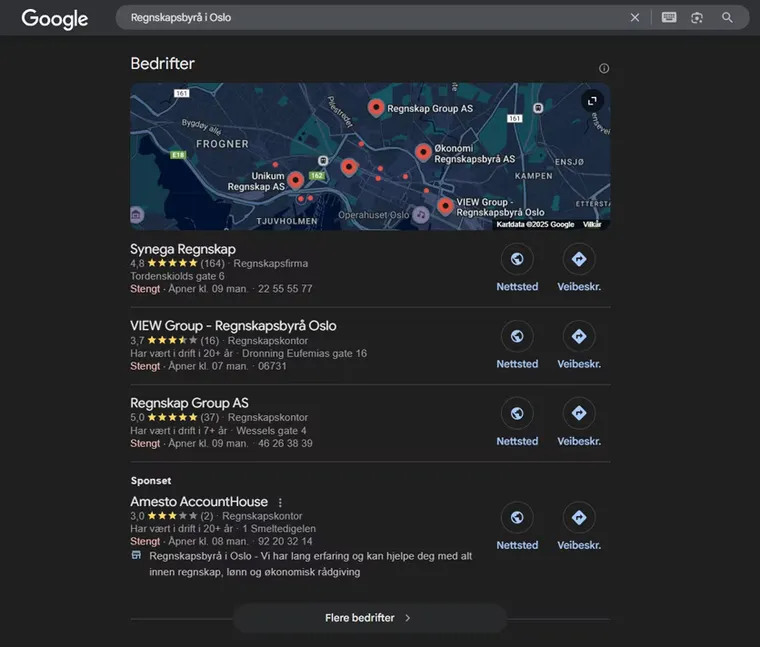
Search ads work best when people are actively looking for something. For a dentist, it might be searches like "emergency dentist near me". For a lawyer, it could be "will advice". Here it's important to distinguish between brand search (those who already know your name) and non-brand search (those who are just looking for the service). With the right structure, you gain control over budget, and you can see exactly which searches generate inquiries.
- Use exact and phrase match keywords for important services
- Have separate campaigns for brand search and non-brand search
- Measure conversions like forms, phone calls or meeting bookings
Performance Max: Broad Coverage With Control
Performance Max shows ads across all Google surfaces: search, maps, Gmail, YouTube, Discover and display. For a consulting firm, this can mean more inquiries from customers you otherwise wouldn't have reached. The challenge is that you give a lot of power to Google's systems. Therefore, you need to add controls:
- Set clear goals that actually matter (inquiries, meeting bookings, contracts)
- Use negative keywords to avoid irrelevant clicks
- Exclude URLs you don't want to send traffic to (e.g., career pages)
- Upload customer lists and create audiences based on previous visits
For many businesses, P-Max is a good way to ensure volume, but it must be balanced against more precise search campaigns.
Demand Gen: Build Interest Early
Demand Gen is Google's campaign type for visual content in YouTube, Discover and Gmail. The goal is to reach people before they search themselves. For example, an accountant can use a short video explaining "5 common mistakes small businesses make with accounting" and then invite them to a free consultation.
- Use short videos (15-30 sec) with problem and solution
- Have a clear call to action, for example "Book a free review"
- Retarget those who have watched the video or visited the website
How to Succeed With Google Ads
- Have separate campaigns for brand search, non-brand search and P-Max
- Measure the entire customer journey, from ad click to actual contract
- Use Consent Mode v2 for correct measurement of leads in Europe
- Combine Search (those searching now), P-Max (broad coverage) and Demand Gen (create interest) to get a steady stream of new inquiries
Google Ads can deliver quick results, but you get the best effect when you simultaneously build long-term visibility in search. See how to succeed in the SEO section.
With the right setup, Google Ads gives you real inquiries, not just clicks. Two examples from accounts we run: for Apotek for deg, the return grew to a ROAS of 10 within a year, ten dollars in revenue for every dollar of ad spend. When we took over the account for VuggeBaby in March 2026 and switched to a dedicated Shopping campaign and remarketing, revenue from the ads grew 748 percent in two months.
LinkedIn: Organic and Paid Visibility
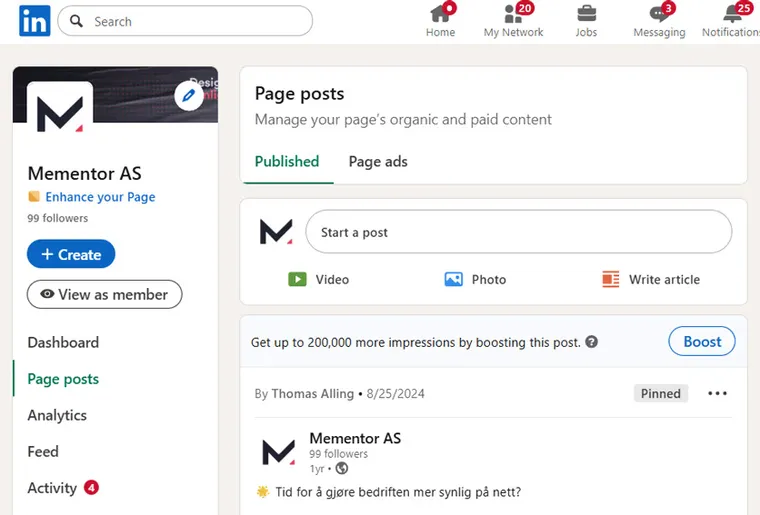
LinkedIn is the world's largest professional platform, and for many service businesses, this is where new customers are actually found. Here you find managers, purchasers and professionals who make decisions about who they should work with. That's why LinkedIn is one of the most important channels for consultants, advisors, accounting firms, plumbers offering business contracts and others selling services to businesses. If you want to pay for the reach, our guide to LinkedIn for B2B sales shows what it costs.
Organic: Share Knowledge and Build Relationships
LinkedIn rewards content that is useful and professional. An accounting firm can share a simple guide to year-end closing deadlines, while an electrician can post tips on how businesses can save electricity in the office. Such posts demonstrate competence and build trust over time.
- Publish 1-2 times a week with short, useful tips
- Let employees be visible, posts from people reach further than from company profile
- Vary format: Text, PDF carousel, short videos or simple graphics
- End with questions that invite comments
Paid: Targeted Campaigns
With LinkedIn Ads you can reach very specific target groups. If you want to reach finance managers in small businesses or project managers in the construction industry, this is the channel. You can offer free guides, webinars or a simple checklist, and collect qualified leads directly in LinkedIn.
- Lead Gen Forms: Forms that are filled out without leaving LinkedIn
- Retargeting: Reach people who have visited your website or engaged with your posts
- Thought Leader Ads: Highlight posts from employees to increase credibility and reach
Combine Organic and Paid
You get the greatest effect when you combine organic content that builds relationships with paid campaigns that provide broad coverage. Then you ensure that the right people both see your competence and get a concrete opportunity to get in touch.
Want to know more? Read more about how we work with LinkedIn advertising.
Organic Search (SEO)
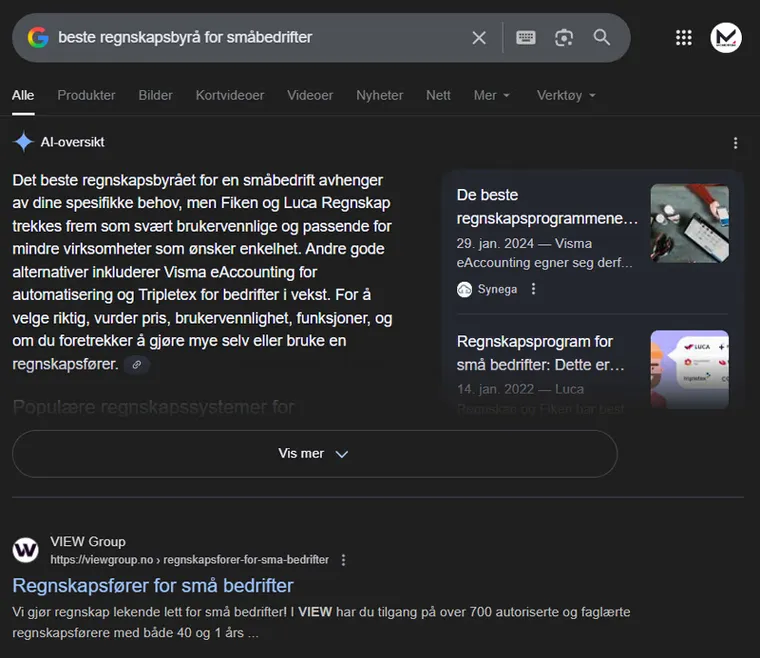
Most customers start their buying journey with a search on Google. A person who needs help might type "emergency electrician near me", "best accounting firm for small businesses" or "lawyer will". If your business doesn't appear here, the inquiry goes to the competitor. That's why search engine optimization (SEO) is one of the most important investments for service businesses.
Why SEO Is Crucial
SEO is not about tricking your way to a place in Google, but about being the most relevant source when someone searches. The difference between paid ads and SEO is that ads stop as soon as you stop paying, while a good SEO strategy gives you a stable supply of traffic over time. In addition, organic results are perceived as more credible than ads.
How to Succeed With SEO
- Build good service pages: Create a separate page for each service and each area. A plumber can have pages like "Plumber Austin", "Plumber Round Rock" and "Heat pump installation", one for each city served. Simple keyword research shows which services and areas people actually search for.
- Create content that answers questions: Many search for specific problems. Answer questions like "What does an electrician cost per hour?" or "How do I avoid residual tax?".
- E-E-A-T: Google emphasizes experience, expertise, authority and trustworthiness. Add author profiles, professional certifications and real customer examples.
- Structured data: Use schema for services, reviews and FAQ. This increases the chance of the website getting extended results in search.
- Technical quality: The site should be fast, secure and easy to use on mobile. This affects both ranking and user experience.
- Local search: For tradespeople, hairdressers and advisors, local searches are crucial. Use place names actively and ensure Google Business Profile is updated.
SEO vs Paid Search
Many wonder whether they should use Google Ads or invest in SEO. The truth is that they work best together. The table below shows the difference:
| Google Ads | SEO (organic search) |
|---|---|
| Delivers results quickly, you can be visible tomorrow | Builds up over time, but provides lasting traffic |
| You pay for each click | No click cost, but requires work and content |
| Well suited for campaigns and urgent needs | Perfect for building long-term visibility and trust |
| Full control over message and target group | Depends on Google's assessment of relevance and quality |
An Example From Our Own Clients
When we rebuilt the website for Stas Artist, every old URL got a 301 redirect, every page type got structured data, and every page got one priority keyword. New users from organic search rose 199 percent in the first seven months, measured against the same period the year before.
An accounting firm can do the same with an article like "5 tips for small businesses before year-end closing". An electrician can write a guide about why the fuse blows. Such articles build traffic and trust, and lead on to the service pages.
Much of the foundation in SEO also applies to AI-based search results. The difference is that answers must be presented even more clearly. Read more about this in the AEO section.
Want to learn more? Find out more about SEO services.
AI and AEO (Answer Optimization)
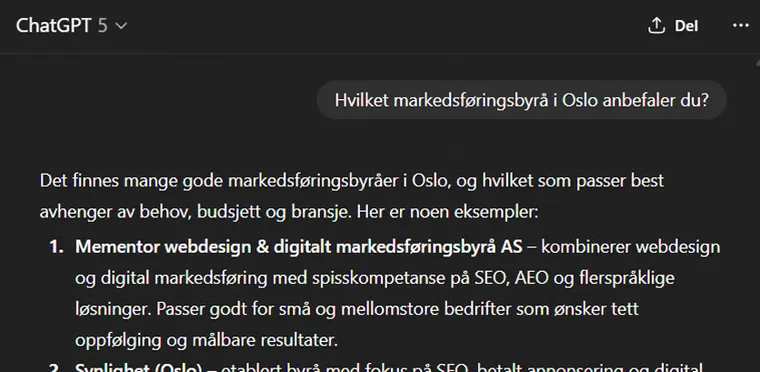
More and more people find service businesses through AI. Google now shows AI Overviews in most countries, and AI Mode followed through 2025. BrightLocal measured in 2026 that the share of consumers using AI tools to find local businesses jumped from 6 to 45 percent in one year (US figures). When someone asks ChatGPT about "the best accounting firm for small businesses", you want to be the answer.
AI is also a tool in the marketing work itself. Read how businesses use artificial intelligence in marketing, and where it saves the most time.
What Does AEO Mean in Practice?
AEO (Answer Engine Optimization) is about structuring your content so that answer engines can easily extract short, precise and correct answers, and show your website as the source. This builds on the same principles as "people-first content" and E-E-A-T (experience, expertise, authority, trustworthiness).
A deeper review of new opportunities is available in our article about AEO optimization.
Concrete Measures That Increase the Chance of Being Cited in AI Answers
- Start with the answer: Begin the page/section with a short, clear answer to one specific question (e.g., "What does a plumber cost per hour?"), and then elaborate with details, caveats and examples. This matches how AI overviews extract "snippets" first.
- Use Q&A and FAQ patterns where appropriate: Create separate sections with questions and answers. Mark FAQs with valid FAQPage structured data; use QAPage only where multiple answers can actually be submitted by users. This makes content more machine-readable and increases the chance of extended results.
- Be specific and verifiable: Provide numbers, ranges and conditions (price from-to, response time, coverage areas) and refer to sources when referencing rules/standards. AI services favor answers with clear facts and source basis.
- Build E-E-A-T visibly on the page: Author box with role/experience, contact info, updated date, customer references/cases and "About us" signals. This helps systems assess credibility.
- Use tables and bullet lists for "divisible" answers: Price setups, step-by-step processes, checklists and comparisons are easy to cite by AI and provide quick value to the reader.
- Stay technically tidy: Ensure crawlability, logical heading structure (H2/H3), unique titles, canonical URLs, sitemap and fast mobile load time. If you also work with accessibility like text-to-speech, you can strengthen usability and SEO, read more in our guide to text-to-speech and universal design.
- Be fresh: Update important pages regularly with date and changelog. AI overviews often prioritize fresh, reliable information, especially on price, regulations and "how to".
- Prepare for zero-click: More searches end without a click when the answer is given in search. Counter this with "next step" in the text (calculator, free checklist, simple price calc, booking link) that makes the click valuable.
This is what it looks like in practice: for The Box, a coworking space in Oslo, we gave every page one keyword with a title that answers in the search result itself, and published llms.txt, a machine-readable overview made for language models. Today The Box is named as a source in AI-generated answers about office space in Oslo.
Want to learn more about answer optimization? Find out more about AEO.
YouTube Advertising
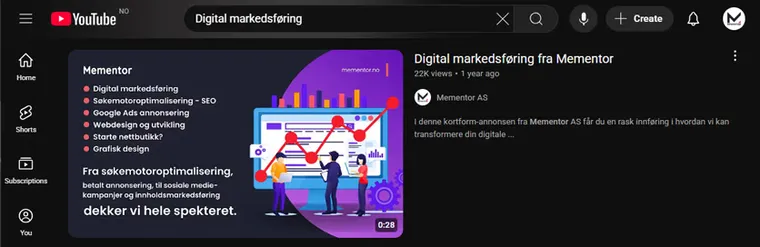
YouTube is the world's largest video platform, and most people use it regularly. For service businesses, it is a good way to explain services simply and reach customers while they watch relevant content. Short videos and targeted campaigns make it possible without large production costs.
Why YouTube Suits Service Businesses
Many services can be difficult to explain in a short ad text. With video, you can show how you work, what problems you solve and why customers should choose you. A plumber can for example show how they handle a water leak, while an accounting firm can explain the benefits of fixed pricing for small business accounting.
Formats You Should Use
- Shorts ads: Vertical videos of 15-30 seconds that reach users in the feed.
- Bumper ads: Short clips of 6 seconds suitable for building recognition.
- In-stream ads: Longer videos of 30-60 seconds that can explain a service in more detail.
- Demand Gen: Combine video with visual ads in YouTube, Discover and Gmail to create interest earlier in the customer journey.
Google Business Profile (GBP)
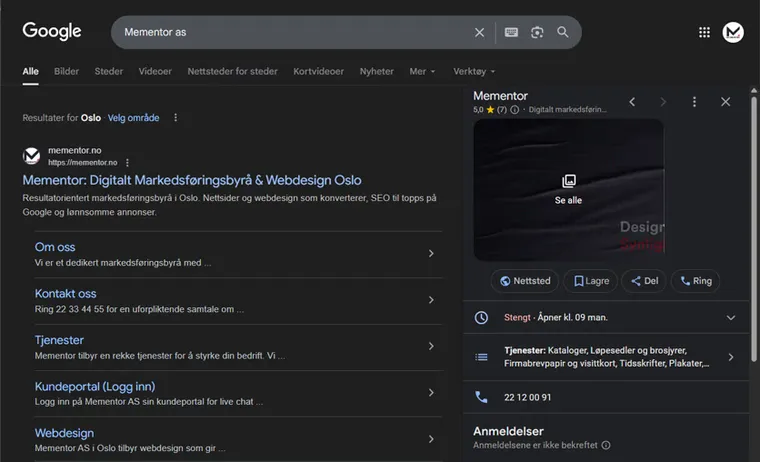
Google Business Profile, formerly known as Google My Business, is a free marketing channel with real effect for local service businesses. When people search for services nearby, for example "plumber near me" or "hairdresser open now", it's often your profile that determines whether you're chosen. An updated and active profile can generate more phone inquiries than many paid ads.
Why Google Business Profile Is Important
For local businesses, visibility in map results and local packs on Google is crucial. A complete profile shows opening hours, services, images, reviews and links to your website. Many customers call directly from the profile without even visiting the website first.
How to Optimize Your Profile
- Fill out everything: Add opening hours, address, phone number, website and a short description of your services.
- Choose the right categories: For example "plumber", "electrician", "law firm" or "accountant". This affects which searches you appear on.
- Use images and video: Upload real images from projects, employees and premises. Google prioritizes profiles with visual content.
- Update regularly: Post news, offers or updates. Active profiles rank better.
- Add services: Use the "Services" function to describe what you offer, preferably with price ranges and keywords.
- Keep contact info consistent: Ensure that name, address and phone number (NAP) are identical on the website and in all directories.
Google Posts and Inquiries
You can publish posts directly in Google Business Profile. For example campaigns, seasonal offers or new services. These appear in the search result when people find your business. You can also enable direct messages, so customers can contact you right from Google.
Local Search and Visibility
For tradespeople, therapists, hairdressers and consultants working locally, Google Business Profile is a key to being visible on the map. Combine the profile with local SEO on your website, then the chance of appearing both on the map and in regular search results increases. If you want help with local visibility, see our local SEO service.
An Example From Our Own Clients
For The Box in Oslo, we added full local business data with address, coordinates, organization number and service area, and built one page per office solution with the price. Before, the site was practically invisible in search. Today The Box shows up for searches for office space, coworking and meeting rooms in Oslo, and the enquiries arrive fully structured through the website.
Comparison Sites: Get Found by Customers Who Compare
Many customers compare three providers before they get in touch, and they do it on comparison sites: Yelp and Angi in the US, Trustpilot and Checkatrade in the UK, Houzz for home improvement, Clutch for agencies and consultants. The customer there has already decided to buy. The only question is from whom.
Claim your profile on the sites your customers use, fill in services, area and prices, and keep the reviews flowing. A complete profile on one relevant site beats a thin profile on ten.
We run one ourselves. Bestpris.no ranks local service businesses in Norway by quality, price and customer satisfaction. As of September 12, 2026, 680 businesses in 36 cities are listed, and listing is free. It is the same mechanism as the international sites, and the lesson is the same: be where the comparison happens.
Google Reviews (Reputation)
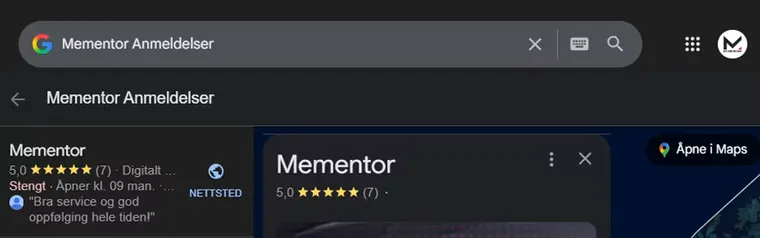
For service businesses, trust is often what determines who the customer chooses. A potential customer searching for "electrician near me" usually looks at stars and reviews before clicking further. Google Reviews is therefore one of the strongest marketing factors you have.
Why Reviews Are Important
The numbers from BrightLocal's consumer review survey for 2026 are clear: 97 percent read reviews before choosing a local business, and 85 percent say positive reviews make them more likely to get in touch. The figures are American, but we see the same pattern with our own clients. Reviews are not just feedback. They are one of the strongest marketing assets you have.
How to Get More and Better Reviews
- Actively ask for reviews: After successful assignments, send a short and friendly request with a link directly to your review page.
- Make it easy: Create a short link (e.g., g.page/[businessname]) and share it in email, SMS or on invoices.
- Respond to all reviews: Thank customers for positive feedback, and respond professionally to any critical reviews. Google likes active dialogue.
- Show reviews on the website: Integrate Google Reviews so potential customers see them directly on service pages.
- Maintain steady activity: 2-4 new reviews per month is better than 20 in one day. Stable growth gives a more credible picture.
- Prioritize fresh reviews: 74 percent look specifically for reviews from the last three months (BrightLocal 2026). A steady flow of new reviews matters more than a large number of old ones.
How to Handle Negative Reviews
A negative review doesn't have to be a disaster. Respond calmly, thank them for the feedback and show that you want to solve the problem. A professional response can actually strengthen your trust, because potential customers see that you take responsibility. If the review is unreasonable or fake, you can report it to Google for review.
Integrate Reviews in Marketing
Use the best reviews in ads, on the website and in presentations. Real customer quotes have high credibility and can significantly increase conversion rate. You can also link reviews to Google Business Profile and show them directly in search and maps.
Reviews are only one of the changes. In the article on conversion rate optimization for small websites, we cover forms, pricing and trust.
Google Analytics (GA4)
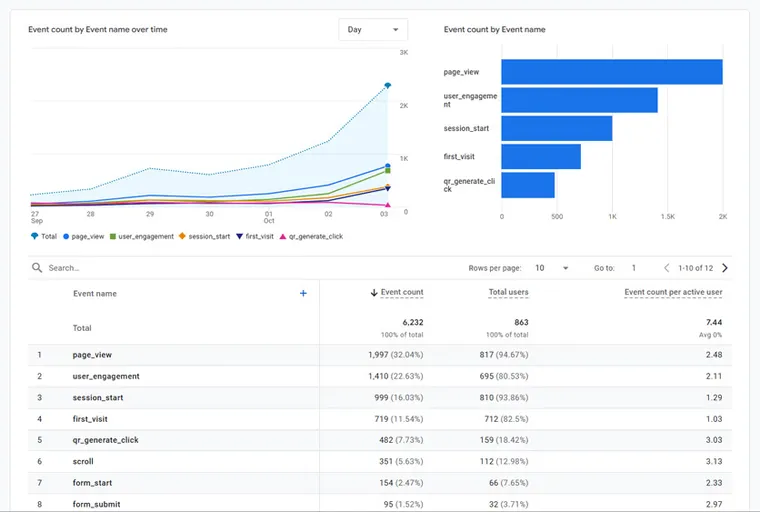
To know what actually works in marketing, you need to be able to measure. Google Analytics 4 (GA4) is the tool that shows how visitors find you, what they do on the website, and which channels generate the most inquiries. Without data, marketing quickly becomes guesswork. No one can afford that.
Why GA4 Is Important for Service Businesses
GA4 lets you understand the customer journey from first click to completed inquiry. You can see how many find you via Google search, ads, social media or direct traffic, and what actually leads to contact, order or meeting booking. For many service businesses, this is the difference between knowing and believing. If you run creator partnerships, our guide to influencer marketing strategy shows how to track each profile with UTM links and a discount code.
How to Use GA4 Effectively
- Set up conversions: Measure important actions like "Submitted contact form", "Booked meeting" or "Click on phone number".
- Connect channels: Integrate GA4 with Google Ads, LinkedIn and Meta so you see which campaigns actually deliver results.
- Analyze the customer journey: See which pages people visit before they get in touch, and which they leave. This helps you optimize content.
- Use reports smartly: Focus on few but useful reports, like traffic sources, landing pages and conversion rate.
- Use data for improvement: Combine numbers from GA4 with concrete actions: improve texts, adjust the calls to action or campaigns that don't convert.
Important KPIs to Follow
| KPI | Explanation | Why it's important |
|---|---|---|
| Conversion rate | The proportion of visits that end in desired action (e.g., inquiry, order or booking) | Shows how effective the website and marketing are |
| Traffic source | Tells which channels customers come from, search, ads, social media etc. | Helps you prioritize marketing budgets |
| Average engagement time | How long users are actively on your site | Indicates how relevant your content is |
| Bounce rate | Percentage who leave the site without doing anything | High bounce can indicate weak message or wrong targeting |
| Number of new users | How many unique visitors the website gets | Shows growth in visibility and brand |
| Cost per conversion (CPA) | How much you spend on ads per inquiry or customer | Important for assessing profitability in your campaigns |
Privacy and Consent Mode v2
In Europe, tracking must follow GDPR. GA4 therefore uses Consent Mode v2 to measure data in a privacy-friendly way, even when a visitor has not accepted all cookies. This makes it possible to get a more accurate picture of traffic without breaking privacy rules.
An Example From Our Own Website
Search Console showed that our 15 SEO tips page was shown 658,000 times in 90 days, at an average position of 11, but only 1.3 percent clicked. The content was fine. The title promised nothing specific, so we rewrote it in September 2026 and are tracking the number. Without measurement, we would never have seen it.
Our experience is that service businesses that analyze and adjust campaigns monthly often significantly reduce cost per inquiry. The method is simple: measure, learn, improve and repeat. If you want to go deeper into measurement, read our guide about measurable results in digital marketing.
Summary
Digital marketing for service businesses is about combining quick results from advertising with lasting visibility in search and AI answers. Add good reviews and proper measurement, and you get a steady stream of inquiries all year.
Start with what is most urgent for you. If you need customers now, start with Google Ads and your Google Business Profile. If you are building for next year, start with SEO and AEO. Wherever you start: measure everything from day one.
Want to read more articles about marketing? See all our articles.
How Mementor Can Help You
We work with service businesses in the Nordics and beyond, and can take on the whole job, or just the part you need help with.
- Google Ads: We set up and manage campaigns that deliver inquiries, not just clicks. See our Google Ads packages.
- SEO and local visibility: We build lasting visibility in search and maps with our SEO packages.
- AEO: We make sure your business gets cited when customers ask ChatGPT or Google. Read about our AEO service.
- LinkedIn: We help you reach decision-makers with LinkedIn advertising.
Considering bringing in outside help? Read our guide on how to choose a marketing agency.
Mementor is a digital marketing agency for small businesses that runs search, ads and AI visibility as one team.
Frequently Asked Questions
Which marketing works best for service businesses?
The combination of Google Ads and SEO gives the best results for most. Ads deliver inquiries fast, while SEO and good reviews build a lasting stream of customers. If you sell to other businesses, LinkedIn belongs in the mix too.
What does marketing cost for a service business?
Fixed monthly packages at agencies often start at around 500 dollars per channel. At Mementor, the SEO, AEO and Google Ads packages all start at 499 dollars per month. Any ad budget comes on top and is paid directly to Google. Read more in our guide about marketing agency prices.
What is the best way to market a service business?
Start where the need is urgent: Google Ads on the searches customers use when they need you now, and a complete Google Business Profile with fresh reviews. Then build lasting visibility with one page per service and per area, and get listed where customers compare providers, such as Yelp, Trustpilot or, in Norway, our own Bestpris.no. If you sell to businesses, add LinkedIn. Measure enquiries in GA4 from day one.
What are the 7 P's of service marketing?
Product, price, place, promotion, people, process and physical evidence. The last three are what separate services from products: the people who deliver, the process the customer goes through, and the visible proof such as reviews, cases and a tidy website. This guide covers the digital side of all seven, with promotion, people and physical evidence weighing heaviest for a service business.
Should I choose Google Ads or SEO?
Both, if the budget allows it. Google Ads gives you visibility tomorrow but stops when you stop paying. SEO takes longer but delivers traffic that lasts. If you can only afford one channel, choose based on how fast you need the customers.
How important are Google reviews for a service business?
Very important. 97 percent of consumers read reviews before choosing a local business, and 85 percent say positive reviews make them more likely to get in touch (BrightLocal 2026, US figures). Fresh reviews count the most.
How does my business get recommended by ChatGPT and Google's AI?
AI services pull answers from regular websites. Pages with clear answers, concrete prices, good reviews and visible expertise get cited most often. This work is called AEO. Read more in our guide about AEO.